
Best use of Artificial Intelligence
How We Built a Real-Time AI Commentary System for Visually Impaired NBA Fans
TL;DR: FCB New York and Michelob Ultra challenged WAV to build a system that would let visually impaired fans at Madison Square Garden follow live Knicks game action through real-time audio commentary — with no more than a 5-second delay from play to announcement. The system was delivered, deployed at MSG, and certified by the American Foundation for the Blind.



The Fan First Experience
Visually impaired fans don’t go to basketball games for the box score. They go for the same reason everyone does — 19,000 people in a room reacting to the same moment at the same time. The roar when a three drops. The groan when it rims out. That collective experience doesn’t require sight.
What it does require is a thread connecting the sound of the crowd to what just happened on the court. Without it, you’re surrounded by a reaction you can’t decode.
FCB New York and Michelob Ultra came to WAV with a precise brief: build that thread. A system that listens to the live game feed and speaks — calmly, in real time, into a fan’s ear — before the crowd noise has faded. On a standard mobile browser. No app required. No special hardware. And certified as genuinely accessible by the American Foundation for the Blind.
The 5-second requirement wasn’t a preference. It was the brief. Miss it and the commentary arrives after the crowd has already reacted, which tells a visually impaired fan nothing useful about what just happened.
What a Fan Actually Hears
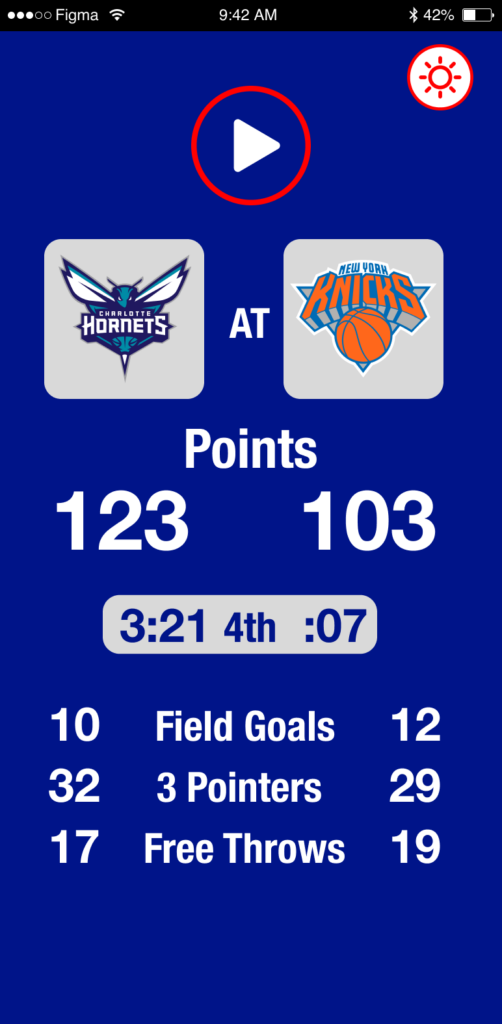
A Knicks possession ends in a made three-pointer. Within 5 seconds, a listener hears:
That’s it. Clean, fast, specific. No delay long enough to break the connection between what happened and the crowd noise surrounding it.
During timeouts, the system fills the air with relevant stats — team shooting percentages, the point leader, recent run differentials. Between plays, when the game clock is running but the ball isn’t moving, color commentary bridges the silence. The hard rule built into the system: nothing longer than 15 seconds of dead air, ever.
The commentary library covers every scoreable play type in the NBA: two-point and three-point makes, layups and jump shots, assisted and unassisted. Each clip runs under 2.5 seconds. Each play type has two delivery modes — standard and “agitated” — so a go-ahead basket in the fourth quarter sounds different from a routine mid-range jumper in the first.
The AFB Certification
The American Foundation for the Blind certification requirement shaped every surface-level decision. The player had to work on any mobile browser — not a dedicated app, not a Bluetooth-paired device, not anything requiring setup at the seat. Screen-reader compatibility and assistive technology interoperability were non-negotiable.
This meant the audio had to be delivered over HLS — the same protocol that powers every major streaming service — and the interface had to be operable without visual reference. A fan should be able to open a URL, press play, and hear the game. That’s the full interaction model.
Certification isn’t a badge in this context. It’s evidence that the system was tested against actual use by actual visually impaired fans and held up.
The Build: For Those Who Want to Know How It Works
The 5-second clock starts the moment SportRadar’s live game feed registers a play. It ends when commentary reaches a listener’s ear.
Everything in between is a pipeline that had to be engineered to run faster than it naturally wanted to.
The numbers.
End-to-end target: 5 seconds. Achieved: 4.8 seconds. The 0.2-second margin is real and accounted for — it comes from the filter-to-audio handoff running at 200 milliseconds, which leaves headroom for network variance in a stadium Wi-Fi environment.
What This Was, Actually
The Dreamcaster franchise was already proof that accessibility and spectacle aren’t in conflict. Courtside extended that proof into real-time infrastructure — the kind of build where the experience only works if the engineering is invisible.
A visually impaired fan at MSG shouldn’t be aware they’re listening to a system built on SportRadar data, a custom filtering engine, LiquidSoap, and SRS. They should just know the game. That’s the brief. That’s what shipped.
Frequently Asked Questions
The Bottom Line
The challenge FCB New York brought to WAV was real: build a system that reliably connects a visually impaired fan to live game action, every possession, in under 5 seconds, at Madison Square Garden. The brief didn’t leave room for “close enough.”
We built to 4.8 seconds because we knew exactly where every tenth of a second in the pipeline was going. That’s what accessible production infrastructure looks like when it’s done right — invisible to the fan, and nothing left to chance in the build.
Published: May 2026 | WAV (We Are Volume) | Production Partner
FCB New York | Brand: Michelob Ultra | NY Knicks | Venue: Madison Square Garden