
Social Video Adaptation & Production: How to Scale Always-On Social at Volume
TL;DR: Social video adaptation turns one master concept into the dozens of platform-native cuts an always-on feed actually needs — every aspect ratio, duration, caption, and localized variant. A single hero concept routinely becomes 12 format variants before a word is translated. The studios that scale it without chaos win on one thing most people underestimate: asset management. WAV runs that engine for agencies as a white-label partner.
What is
Social Video Adaptation?
Social video adaptation is the production process of taking one master video and re-cutting it into every format a social program requires different aspect ratios, durations, captions, and language versions so a single concept performs natively on every platform it runs on. It is a volume and organization discipline, not a creative one.
The creative idea is fixed before adaptation starts. The work is making that idea land correctly in a 6-second 9:16 TikTok cut, a 30-second 16:9 YouTube pre-roll, and a captioned 1:1 Meta placement without re-shooting, and without losing track of which version is approved, which is live, and where.
Your 16:9 hero won’t fit a vertical feed by force. Resizing isn’t reshaping — every format is a different door, and the asset has to be rebuilt to pass through. That’s social video adaptation.
We run it for agencies, behind the team.
How Social Video Adaptation Actually Works
Most agencies treat adaptation as an afterthought to the shoot. Then the always-on calendar starts demanding output every week and
the wheels come off not because the editing is hard, but because nobody built a system for the volume. Here is the operational reality.
Master setup and
the adaptation matrix
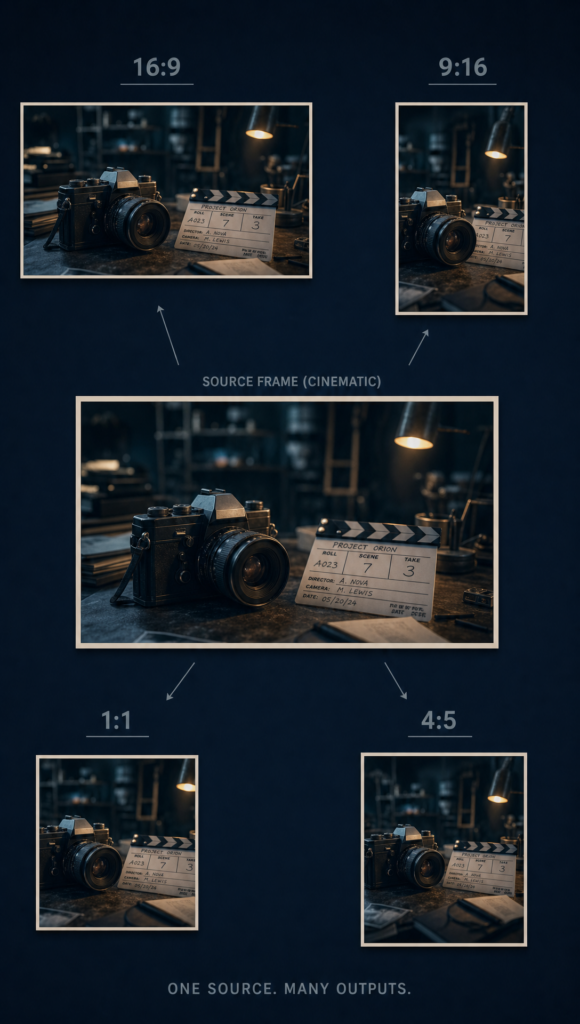
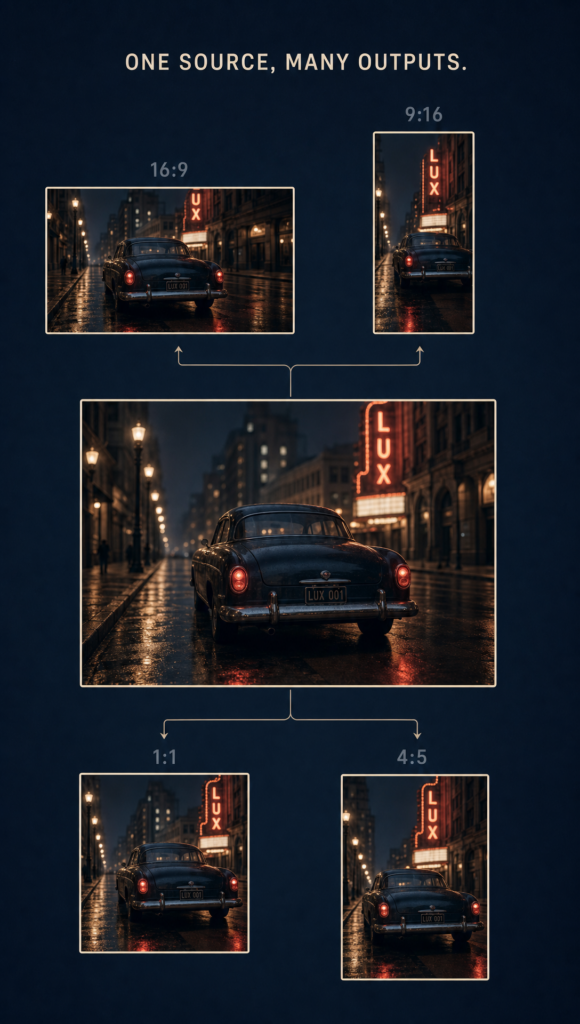
Every concept starts with a designated master: the highest-resolution, highest-fidelity cut, edited at the native ratio the footage was shot for. The master is the single source of truth. Nothing ships from a derivative that can’t be traced back to it. From the master we build an adaptation matrix that is a grid of every required output. A modest matrix is four aspect ratios (9:16, 1:1, 4:5, 16:9) with three durations (6s, 15s, 30s).
That’s 12 deliverables from one concept before localization.
Each cell has its own safe-area, caption position, and platform spec. A logo lockup that sits clean in 16:9 collides with the TikTok UI in 9:16 and our matrix approach forces those decisions up front instead of in the comments of a review link.
Asset management
and version control
This is the part that decides whether a program scales or collapses, so it gets its own section below.
The short version: every derivative is named, versioned, and tied to its master, so when legal swaps a claim in week six, we know exactly which 40 files need to be re-cut and where each one is running.
Captioning, localization,
and platform specs
Captions are produced as a tracked variant, not burned in blindly, open captions for sound-off feeds, closed where the platform supports it. Localization runs off the master so a Spanish 15s cut is a sibling of the English 15s cut, not a fork that drifts over time.
Final exports are conformed to each platform’s current spec sheet, which changes more often than anyone budgets for.
The Volume Problem:
What Always-on Social
Actually Requires?
Brands and agencies budget for “a video.” Always-on social needs a feed that never goes stale, which is a fundamentally different number.
Run the math on a deliberately modest program.
Three hero concepts a week, each adapted into the 12-cell matrix above, is 36 unique exports a week or roughly 1,870 units a year. Add localization across three language markets and you’re at 108 a week, more than 5,600 a year. That’s before paid cutdowns, A/B variants, and the in-flight refreshes a real campaign demands. (Illustrative; actual volume depends on cadence, channel mix, and market count.)
Most people see that number for the first time when the program is already live and the team is already behind.
The point of putting it in front of agencies early is that it reframes the conversation: always-on social isn’t a creative-capacity question, it’s a production-throughput-and-organization question. Which is exactly the part agencies are least staffed for.
The Volume Problem Illustrated:
Always-on Social Volume Calculator
Specs are approximate references, not gospel. Resolutions are accurate but durations, file caps, and especially safe-zone insets drift as platforms update their UI. Verify against current TikTok / Meta / Pinterest creative templates before locking a SOW. Data reflects knowledge as of early 2026.
Why Asset Management
Is the Whole Game?
Adaptation is a solved problem at the level of any one file. Anyone can re-crop a video. The reason most always-on programs degrade over a quarter is that nobody can answer simple questions fast enough: Which version is approved? Which is live on which platform? When the master changed, did every derivative get updated? Asset management is what turns a pile of files into a system that holds up at volume.
There’s a reason WAV is fluent in this. We built our organizational discipline producing MLR-compliant pharma video and Veeva CLM content, where a single untraceable claim is a regulatory problem, not a cleanup task. Consumer and CPG social moves faster, but the volume is higher — and the studio that can keep regulated assets traceable can keep an always-on feed organized in its sleep.
Here is what disciplined organization actually means in production:
A master/derivative tree.
One master per concept.
Every cut, caption, and localization is a tracked child of that master.
Nothing is an orphan.
When you open any file, you can trace it back to its source in one step.
A naming taxonomy that’s machine- and human-readable.
A filename like BRAND_AlwaysOn_2026Q3_C07_9x16_15s_EN-cc_v3.mp4 tells you the program, quarter, concept number, ratio, duration, language, caption state, and version without opening it.
Multiply that discipline across 5,600 files a year and it’s the difference between a searchable library and a landfill.
When a claim, logo, or super changes in the master, the system flags every derivative built from it.
We know the 9:16 15s Spanish cut needs a re-export and that v2 is the one currently live on Meta.
That traceability is the whole job.
Retrieval and reuse.
A library built right means next quarter’s always-on draws from existing masters and approved elements instead of reshooting.
Organization isn’t overhead; it compounds into lower cost
per deliverable over time.
Social Video Adaptation vs. Net-New Production
Adaptation and net-new aren’t competitors. The smart structure is a small number of net-new hero concepts feeding a high-volume adaptation engine. The hero work justifies the budget; the adaptation engine fills the calendar.
| Factor | Social Video Adaptation | Net-New Production |
| Cost per deliverable | Low — one shoot amortized across dozens of cuts | High — every asset originated from scratch |
| Speed to feed | Days; matrix is pre-defined | Weeks; new concept, shoot, post each time |
| Brand consistency | High — all cuts trace to one master | Variable — drift across separate productions |
| Volume ceiling | High — built for always-on cadence | Low — capacity-bound by shoot schedule |
| Best use | Always-on social, paid variants, localization | Tentpole launches, hero films, new creative platforms |
What Great Social Video Production Looks Like
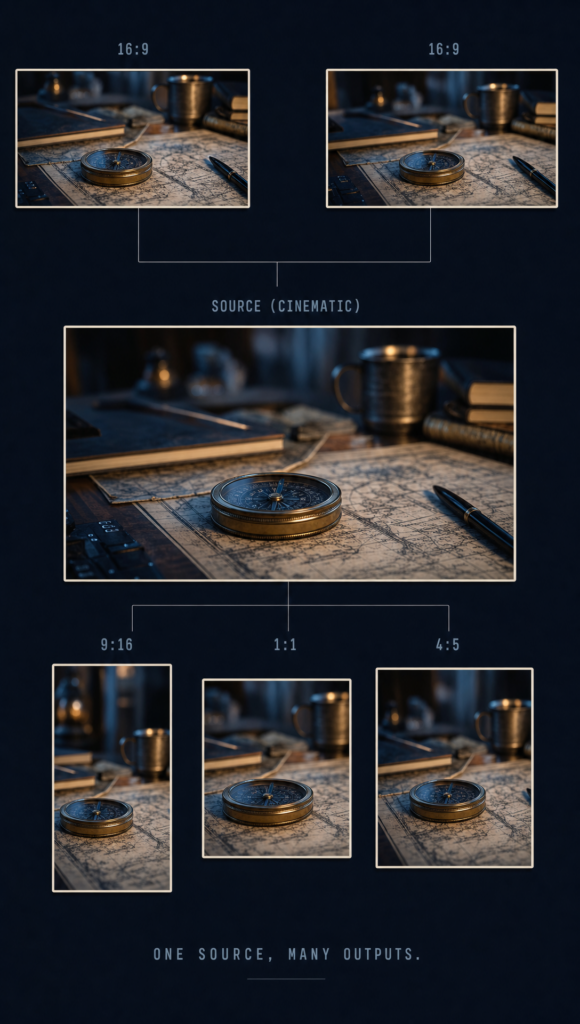
Good adaptation production is invisible. The agency’s brand stays front and center; the volume just appears, on spec, on time, every week. Behind that, a few things are always true.
We define the full adaptation matrix before a single export, so the work is scoped, not discovered mid-flight. We name and version every asset from the first file, not when the folder gets messy. We treat the master as sacred and never let an unapproved derivative ship. And we build the library so the program gets cheaper per asset as it matures, because reuse is designed in rather than bolted on.
The test of a production partner isn’t whether they can cut a good 15-second spot. It’s whether they can deliver 5,000 of them a year and tell you, instantly, the status of any single one.
How to Evaluate a Social Video Production Partner
If you’re an agency deciding who runs your adaptation volume, these are the questions that separate a real production engine from a shop that will be underwater by week six.
- “Walk me through your file naming and versioning system.”
- Good answer: A specific, documented taxonomy and a master/derivative model they can show you.
- Flag: “We keep it organized in the project folder.”
- “When a master changes, how do you find every derivative built from it?”
- Good answer: Tracked relationships, a flagged re-export list.
- Flag: manual search, or visible hesitation.
- “What’s your weekly sustained output ceiling, in deliverables?”
- Good answer: A real number tied to staffing and system.
- Flag: “As much as you need.”
- “How do you handle localization without versions drifting?”
- Good answer: Localized cuts as siblings off the master.
- Flag: localization treated as a separate project.
- “How do you track rights and usage windows across the library?”
- Good answer: Asset-level tracking with expiry flags.
- Flag: “The client handles that.”
- “Can you produce to regulated specs if we need it?”
- Good answer: Yes, with named experience (MLR, compliance).
- Flag: a vague yes.
- “What do I actually receive at delivery?”
- Good answer: A labeled, structured package mapped to the matrix.
- Flag: a shared drive link.
Frequently Asked Questions

WAV partners with a small number of agencies at a time — typically 2–3 new studio relationships per year — to ensure each partner gets a fully embedded, senior-level production team. If you’re running over capacity or looking for a production partner who knows Pharma, Web, Display, and Email inside out, 2026 has availability. The best digital studios aren’t built. They’re partnered with.
“WAV doesn’t feel like a vendor – they feel like our team members who happen to work remotely. The quality is consistently excellent and we never worry about capacity planning anymore.”
~2025, The Horses Mouth